Hidden Out-of-State Risks DFW Relocation | Louis Pacheco
When moving to Dallas-Fort Worth from out of state, the initial focus is almost always on the purchase price. Buyers see more square footage for their money and assume the financial equation ends at closing. That is a mistake. The true cost of owning property in North Texas is hidden in the monthly carrying costs, geographical risks, and logistical realities that online listings simply do not show.
Here is the direct answer: Relocating to DFW requires calculating high property taxes, aggressive homeowner insurance premiums driven by severe weather, and daily toll road expenses. Without factoring in these exact variables, out-of-state buyers risk stepping into a heavy financial burden immediately after moving.
Why Are Texas Homeowners' Insurance Rates So High?
Buyers often assume that if a house costs the same in Texas as it did in their previous state, the insurance premium will be identical. This is the risk most people miss. North Texas sits in a geographic zone prone to severe spring storms, large hail, and high winds. Insurance carriers price these risks directly into your premium.
You are not just insuring the structure against fire or theft; you are insuring the roof against inevitable hail damage.
When reviewing policies, pay immediate attention to the wind and hail deductible. In many states, deductibles are a flat fee, like $1,000 or $2,000. In Texas, wind and hail deductibles are typically calculated as a percentage of the dwelling coverage (often 1% or 2%).
Here are some steps to mitigate insurance shock:
Demand a Roof Age Verification: Always confirm the exact age of the roof during the option period.
Request the CLUE Report: This report shows the property's insurance claim history. Multiple recent claims can indicate a problematic micro-climate or make the house harder to insure.
Quote Before You Commit: Get a hard insurance quote during your option period, not two days before closing.
How Do DFW Property Tax Realities Impact Your Monthly Payment?
Texas does not have a state income tax. To fund public services, the state relies heavily on property taxes. DFW property tax realities are often the biggest shock to families moving to Dallas-Fort Worth.
Depending on the specific city and school district, property tax rates in the DFW metroplex generally range from 1.8% to 2.8% of the home's assessed value. A home with an attractive sticker price in a new suburb might carry a much higher tax rate than an older home just one town over. Do not look at the seller's current tax bill. Look at the tax rate applied to your purchase price.
Hypothetical Tax Breakdown on a $500,000 Assessed Value
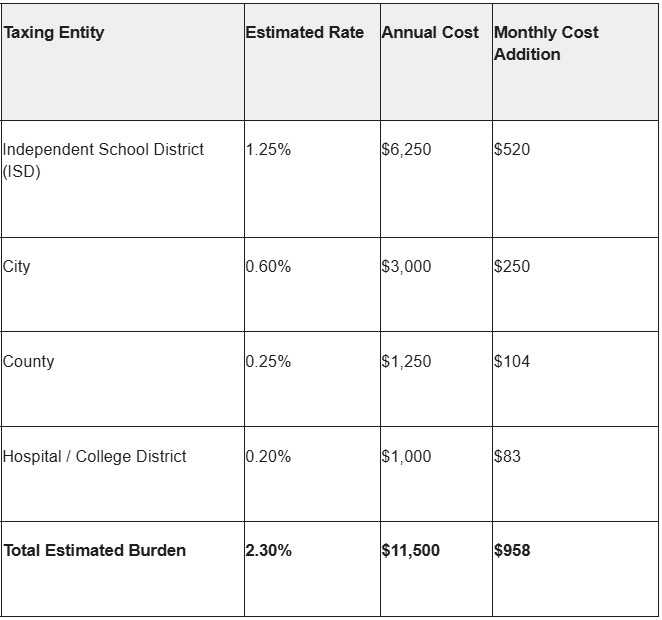
Note: This is a general framework. Rates vary wildly by exact address.
You must also verify if the home is subject to Public Improvement District (PID) or Municipal Utility District (MUD) taxes. These are additional assessments used to fund infrastructure in newer communities. They can add hundreds of dollars to your monthly carrying cost.
What Do Dallas-Fort Worth Commute Times Actually Look Like?
The DFW Metroplex is massive. It covers over 9,000 square miles. Out-of-state buyers frequently map the distance from a prospective house to their new office and assume a 20-mile drive will take 25 minutes.
Dallas-Fort Worth commute times are dictated by infrastructure, not just distance. The highway system relies heavily on tollways managed by the North Texas Tollway Authority (NTTA).
If your daily commute involves the Dallas North Tollway (DNT), the Sam Rayburn Tollway (SRT), or the President George Bush Turnpike (PGBT), your transportation budget needs an immediate adjustment.
Here are some commute realities to calculate:
The Toll Budget: A daily round-trip commute on NTTA roads can easily cost $150 to $250 per month.
The Choke Points: Highway interchanges (like the I-35W and I-820 mixmaster in Fort Worth or the US-75 and I-635 interchange in Dallas) experience heavy congestion.
The East-West Divide: Traveling north to south in DFW is generally straightforward. Traveling east to west across the mid-cities can be slow and unpredictable.
Always test the commute via GPS during actual rush hour times (7:00 AM and 5:00 PM Central Standard Time) before making a decision.

Why Is Local Neighborhood Reconnaissance Non-Negotiable?
Buying a house sight unseen or relying entirely on a virtual tour is a significant tactical error. A wide-angle lens makes spaces look larger, and bright editing hides structural flaws. More importantly, the camera never shows you what is happening directly across the street.
When executing your DFW relocation checklist, physical reconnaissance is the most important step. You need a trusted party to evaluate the environment, not just the floor plan.
Online listings may hide environmental risks like:
Flight Paths: DFW International Airport and Dallas Love Field have extensive, active flight paths. A beautiful house might sit directly under a low-altitude approach route, resulting in heavy daily noise pollution.
Train Tracks: Active freight lines run directly behind many residential fences in DFW suburbs.
Soil and Foundation Indicators: North Texas soil expands and contracts aggressively with the weather. Online photos will not show the vertical cracks in the exterior brick or the separation around window frames that indicate foundation movement.
Commercial Zoning: That empty field next to your targeted subdivision might be zoned for a massive warehouse distribution center.
You need eyes on the ground. You need an advocate who walks the perimeter and identifies the liabilities before you write a check.
The Hidden Liabilities of DFW New Construction
A common strategy for out-of-state buyers is to default to a new build. It feels safer. The logic is that a brand-new house eliminates the need for inspections and immediate repairs.
This is a massive oversight. Builder contracts are legally drafted to protect the builder's timeline and profit margins, not your relocation schedule.
Some of the new build traps to avoid include:
Escrow Exposure: Builders require massive, non-refundable earnest money deposits. If your relocation falls through or your out-of-state home fails to sell, that money is entirely at risk.
The "Improved Value" Tax Shock: In year one, your property taxes are often assessed on the value of the empty dirt. In year two, the county assesses the fully built home. Buyers frequently face a massive, unbudgeted escrow shortage when the true tax bill hits 12 months later.
Skipping Independent Inspections: Never skip a third-party inspection on a new build. Municipal inspectors check for basic code compliance. They do not check for the quality of framing, missing insulation, or poorly graded drainage.
You need independent representation. The sales agent in the model home works for the builder's bottom line, not your family's financial protection.
How Louis Pacheco and The Pointman Real Estate Team Can Help
Relocating across the country is chaotic. You are managing logistics, employment changes, and a family transition all at once. As an experienced realtor, I (Louis Pacheco) can help protect you from surprises.
My team and I at The Pointman Real Estate operate on structure and process. We do not chase trends, and we do not sell hype. We act as your guide in high-stakes decisions, ensuring you have total clarity on taxes, insurance, and local risks before you ever sign a contract.
When you work with us, you are not rushed into a transaction. You get the unvarnished truth about the property and the neighborhood. We handle the reconnaissance, we identify the risks, and we provide the straight answers you need to make a solid, protective decision for your family.
Real estate with structure. Guidance when it matters.
Frequently Asked Questions
How much are property taxes in DFW?
Property tax rates in the area typically range from 1.8% to 2.8% of a home's assessed value. The exact rate depends on the specific city, county, and school district the property is located in. Texas has no state income tax, so property taxes are the primary funding mechanism for local services.
What is the average commute time in Dallas-Fort Worth?
The average one-way commute is roughly 27 to 30 minutes, but this varies significantly based on your route. Commutes that rely heavily on major tollways or cross major highway interchanges during rush hour can easily exceed 45 minutes to an hour.
How often do roofs need replacing in North Texas?
Due to frequent severe weather and hailstorms, roofs in North Texas are replaced much more often than the national average. It is common for a composite shingle roof in DFW to be replaced every 7 to 12 years, making roof age a critical factor during the inspection period.
What should be on a DFW relocation checklist?
A thorough relocation checklist must include verifying property tax rates, securing a hard quote for homeowners' insurance (paying attention to wind/hail deductibles), mapping exact commute times during rush hour, and conducting physical neighborhood reconnaissance to check for noise pollution and foundation issues.
Clarity before commitment. If you are planning a move to North Texas and want a structured, risk-aware approach to buying property, I can help. Reach out to me today to establish your execution plan.